Politique
-US President-elect Barack Obama unveils details of his "21st century New Deal". The Economic Recovery Plan is preliminarily based on 5 pillars: energy, roads and bridges, schools, broadband, and electronic medical records. Many, including prominent members of his own party, are becoming increasingly frustrated with his "there is only one president at a time" line, as the sitting President appears to have checked out while Rome burns.
-The terrorist attacks on Mumbai end, the Indian investigation expands, and at least 29 people die from a car bomb in the Pakistani city of Peshwara. Blame for the attacks has focused on Pakistan-based Lashkar-e-Taiba (the likely perpetrators), the Indian government (early warnings, poor response, failure to hold Pakistan accountable), and the Pakistani regime (failure/inability to address sources of terrorism and militancy within its borders).
-A deliciously intriguing affair in the British House of Commons has ignited a fierce debate over Parliamentary independence, opposition politics, and police powers. Meanwhile, Canada has its own legislative controversy to deal with (find Dave's take here).
Economia
-The US learned it has been in recession since December 2007 (something everyone but this guy has been well aware of) and lost 533,000 jobs in November, the largest jobs decline in 34 years.
-Angela Merkel grew increasingly isolated in Europe as French President Sarkozy unveiled a €26bn stimulus package. UK Prime Minister Brown and Sarkozy will meet in London on Monday to renew their call for a coordinated European stimulus.
-An historic week in European central banking: BoE cuts 100 basis points to 2.0% (lowest level since 1951), ECB goes with 75 basis points to 2.5% (its largest single cut ever), and Sweden slashes a record 175 basis points to 2.0%.
The Rest
-In the Prem: Arsenal continue form following famous win at Stamford Bridge, Liverpool stay top, and ManU and Spurs on track for Carling Cup final. In Europe: Cristiano Ronaldo wins Ballon d'Or, reveals he was "an inch away" from being a Gunner in 2003.
-This week in Japanese innovation: omelets with the Motoman SDA10.
-"Experienced bandits" steal €85mn in luxury jewels from Harry Winston store in Paris. According to Reuters, the heist occurred almost a year to the day of a similar $16mn robbery at the store.
Saturday, 6 December 2008

Friday, 5 December 2008
Adventures in economic stimulus
 Are you a city tired of waiting for an effective national response to the economic recession? In desperate need of economic stimulus, but nowhere to turn? Well, Milwaukee, USA has a solution for you.
Two Milwaukee neighborhoods are considering printing their own money for local exchange.
Before the dollar rally, there was some worry about a run on the greenback. The thought was that the credit crunch, fiscal expansion, and a general collapse in confidence would undermine the dollars reserve currency status, as well as the willingness of countries like China to purchase Treasuries. But as I predicted at the time, the exact opposite has occurred: the dollar has surged to multiyear highs as investors sprint to safety, the bursting of the commodity bubble withdraws hot money from commodity currencies, and emerging markets plummet.
With foreign investors clearly content in low-yielding dollar investments, could the biggest risk to the greenback be Americans themselves? Of course not. But it is pretty amusing to think of local currencies sprouting up all over the US. Apparently, this is not without precedent, and Ron Paul would surely be happy.
My vote for Milwaukee's new currency: the "GreenPack" (Green Bay Packers, for those of you unfamiliar with America's greatest sports franchise and Doyle family obsession).
Special note to 50% of Packers Nation- a Favre bill was all I could find. We have to get over it at some point. Right?
Thursday, 4 December 2008
Zim on the brink
 Just when things couldn't possibly get worse in Zimbabwe, they tragically do. Zim's health minister has declared a national emergency, as a cholera outbreak has claimed the lives of at least 565 people. The UN estimates that more than 12,500 are infected, and given the water, sanitation, and medical situation in the country, the death toll may rise substantially. The WHO believes these estimates may be significantly lower than the actual figures.
The cholera outbreak not only underlines the collapse of the state under Mugabe, but the danger posed by the current deadlock in powersharing talks between Zanu-PF and the MDC. The country is in desperate need of a new government, and the foreign aid and assistance that will likely coincide with such a transition of power. Aid is essentially frozen in boycott of Mugabe, and a large part of the medical system's failure can be attributed to the brain drain and flight of skilled workers (including doctors and nurses) that Mugabe has instigated.
There is hope. The health minister's announcement coincided with perhaps the strongest condemnation of Mugabe by an African leader to date. Kenyan Prime Minister Raila Odinga has branded the powersharing talks "dead" and called on African governments to "push [Mugabe] out of power". However, as Odinga acknowledged, Mugabe basically serves at the will of the South African government, and only serious action by the ANC to push Mugabe out will succeed.
South Africa's cabinet has called an emergency meeting to discuss the deteriorating situation in Zim. It is time the ANC stood up and assumed the responsibility it has for the crisis to the north. Jacob Zuma and the African Union are confronted with an opportunity to rid Zim of Mugabe forever. It is their duty to turn the human devastation of the cholera outbreak into a new beginning for Zim and its people. They must act now.
Wednesday, 3 December 2008
Hank Paulson is lost, stupid, probably both
 The US Treasury is reportedly considering direct intervention in the mortgage market to stimulate the US housing sector.
Finally!!! Paulson has come to his senses, recognized that our economy is doomed without direct support to subprime mortgage holders, and will stem foreclosures through federal action.
Wait...what? You mean, he wants to respond to the housing crash by re-inflating a housing bubble? He doesn't want to prevent millions of foreclosures? Rather, encourage artificially low rate mortgages and securitization? We don't need to keep people in their homes, but need to get more people to buy more homes they can't afford, in the midst of a recession?
What!?!?!
Double Down: When One Crisis Is Just Not Enough!
The first six articles on the front page of the Financial Times this afternoon read as follows:
- "Record contraction in US services sector: Private sector sheds most jobs in six years"
- "Record number of companies at risk of default"
- "More grim data pushes Wall Street lower: job cuts worse than expected"
- "Markets braced for big rate cut: Bad economic data continue to flow from leading economies"
- "Blackberry maker warns on slower growth"
- "Commodities prices at six-year lows"
Not exactly cheerful news. And yet it is in precisely these grim economic times that the politicians of one of the best-performing rich countries have decided to instigate a political crisis. All by themselves. Non-residents will be forgiven for not having heard about Canada's most recent political circus - you will also be forgiven for continuing in that blissful ignorance.
As I alluded to, Canada's economy has so far held up extremely well compared to the rest of the G7. However, the knock-on effect of recessions in the economies of Canada's biggest trading partners is likely only to be delayed and dulled, not avoided. Given that, Prime Minister Harper's decision last Thursday to use his "economic update" in parliament as an excuse to kneecap both opposition parties and public servants was pretty shameful. See Paul Wells for more on that score.Equally shameful was the response of the various parties that make up the parliamentary opposition. Within weeks of decisively losing a federal election, the three opposition parties have decided, in their collective wisdom, that rather than blocking the PM's maneuver with their combined majority or even (horrors!) suggesting a viable policy alternative, they will form a coalition and take over the government.
The battle lines have been drawn and both sides are working ferociously to brand the other as unpatriotic, irresponsible, power-hungry nutters. Both sides are winning; meanwhile, Canadians everywhere are the losers.
Let me quickly address some of the main issues. First of all, there is nothing in principle wrong with the idea of a separatist party engaging in a government coalition. Moreover, since both sides have relied on said "separatist" party to support their agenda, there is equal parts hypocrisy on all sides. As far as the complaint by the opposition that the economic update did not include appropriate measures for fiscal stimulus... I got yer fiscal stimulus: right here!
I will finish with an open letter to Canada's legislators:
Dear Conservative, Liberal, New Democratic and Bloc Parties,
Grow up.
Russian Demographics: Grandpa Bear

Rory is our resident Russia specialist with excellent articles on geopolitics, energy security and market conditions. But, in addition to these big, sexy topics there's one issue that is a serious concern to Russians and the future of their country: demographics.
Not only has the population been shrinking since about 1992, but a recent study suggests that the population is getting older faster. In addition, high levels of suicide and abortion (not to mention alcoholism, violent crime...) have prompted some to suggest that Russians have lost faith in their system - a finger is pointed at Putin.
Is that the best explanation? I know that I would be thoroughly discouraged if I lived in today's Russia, but there are plenty of places in the world where your future prospects are just as poor as under the Putinocracy that still have high population growth rates.
Russia's population growth is -0.474%. For a country of what is now 140 million people, that's a decline of over 660,000 per year. For comparison, of the G7 countries, only Japan and Germany have negative population growth rates, and even then just barely. Surely we can't still attribute this to the transition from communism - that's a decade and a half ago.
What if it's just the weather? Nearby Estonia, Lithuania and Latvia all share similarly dark & dreary climates; their population growth rates are -0.632%, -0.284%, and -0.629%, respectively. Personally, a dark wintery climate seems ideal for staying inside and making babies, but what do I know? Combine this with lack of political freedoms, and it appears to be a recipe for population disaster.
Not only has the population been shrinking since about 1992, but a recent study suggests that the population is getting older faster. In addition, high levels of suicide and abortion (not to mention alcoholism, violent crime...) have prompted some to suggest that Russians have lost faith in their system - a finger is pointed at Putin.
Is that the best explanation? I know that I would be thoroughly discouraged if I lived in today's Russia, but there are plenty of places in the world where your future prospects are just as poor as under the Putinocracy that still have high population growth rates.
Russia's population growth is -0.474%. For a country of what is now 140 million people, that's a decline of over 660,000 per year. For comparison, of the G7 countries, only Japan and Germany have negative population growth rates, and even then just barely. Surely we can't still attribute this to the transition from communism - that's a decade and a half ago.
What if it's just the weather? Nearby Estonia, Lithuania and Latvia all share similarly dark & dreary climates; their population growth rates are -0.632%, -0.284%, and -0.629%, respectively. Personally, a dark wintery climate seems ideal for staying inside and making babies, but what do I know? Combine this with lack of political freedoms, and it appears to be a recipe for population disaster.
Maybe these guys just need a little sun.
(estimates courtesy of CIA World Factbook; image from arachnoid.com).
(estimates courtesy of CIA World Factbook; image from arachnoid.com).
Saturday, 29 November 2008
Comments Feature Updated
We were dismayed to learn that our comments section had only been available to users with registered Google accounts. That has been changed, so everyone is now free to comment as they see fit.
Apologies.
Apologies.
Friday, 28 November 2008
Obama wants you LSE grads!
A political economy theory of fashion
Does the health of macroeconomy have an impact on fashion? That's a question I've been wondering about recently. I don't know anything about fashion, but intuitively it seems that there must be some sort of connection between what sort of clothes people wear and the overall health of their economic situation. I mean, wealthy people tend to dress "better" than poorer people - that is to say, their clothing is more aesthetically appealing, judged by the standards of the day. Can we extend that trend to the whole economy and compare between eras?
Well that's exactly what I'm going to try to do here. My idea is that people tend to be more stylish during periods of economic boom. It's not an airtight theory, but it's Friday so bear with me. I realize there's a problem from the outset. I'm subjectively biased towards fashion in that I'm more likely to favour current fashion trends over older ones - it's what I'm used to wearing and seeing around me. But I think, even with that in mind, it's not too difficult to look back at history and say: yes, those people looked sharp, or, oh God! something was horribly, horribly wrong. Also, I'm sticking to North-Atlantic economies because I know less-than-nothing about fashion in the rest of the world. So let's start with post-WW1
1920s
The Roaring Twenties - a few minor recessions notwithstanding, economic growth in the twenties was impressive. It was the Jazz age, there was the jitterbug, and of course there was the infamous stock market bubble. Everyone owned stocks. From Wall St. barons down to their limo drivers, stock tips were being shared and discussed in everyday conversation. Everyone was getting rich.
What do we see? For the women: some funny-looking stockings & bathing caps, this is not bad, nor this. A little, er, old fashioned but classy nevertheless. Same goes for the men: the three piece with hat & hankerchief. And of course Al Capone: badass.
1930s
The Great Depression. Clearly some people managed to stay largely unaffected by the extended economic downturn, but with unemployment at 20%+, things tended to be a little more sober. Or worse. Enough said.
1950s - 1960s
Post-war recovery was remarkably rapid, even in Europe. Economic growth, particularly in the 1960s under Kennedy and Johnson, was averaging around 5-6% per year - that's unbelievable by today's standards. This was the era of cheap oil & boat-sized sedans, big industry and safe union jobs. As Patrick at zzzeitgeist pointed out, it was a period of unrestrained consumption.
And man, they looked sharp. The fedora continued to reign supreme. No complaints about the introduction of the mini-skirt, either. Or maybe I've just been watching too much Mad Men.
Of course, I'm forgetting the hippies. But the hippy movement didn't really take off until the late 60s and early 1970s - and by 1968 the economic policies of the previous decade had begun to hit the wall....
1970s
Let's take the period from January 1970 until the end of 1982: that's thirteen years or 156 months. According to economist Timothy Taylor, the US economy spent 49 of those months in recession (re: negative growth). That's almost a third of a decade n' change spent in recession. Yikes.
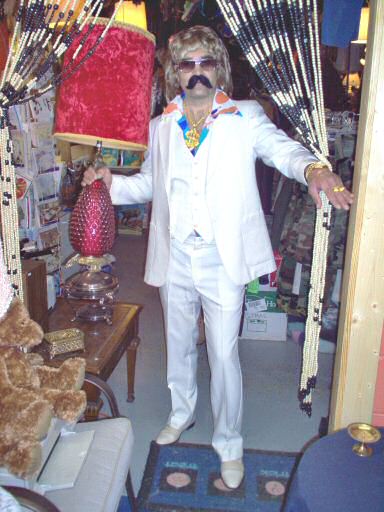
As for the fashion, well - there are no words. Like monks flagellating themselves to atone for their sins, people in the 1970s attempted to make up for their previous economic excesses by forcing themselves to wear horrible, horrible things and listening to disco music. I can't even begin to... what were they... the fat tie... David Bowie!? Make it stop. Please, make it stop.
1980s - early 1990s
The 1980s were sort of a hangover from the 1970s. There were a couple of recessions and government debts rose rapidly. Conservative politicians in the US, UK and Canada implemented neoliberal economic policies, which led to economic pain and social displacement in many areas of the economy.
As my theory predicts, the 80s is known for some pretty questionable fashion taste. We've got the Big Hair, exhibit A, B and OMG. Of course the MC Hammer parachute pants and the hip hop square-cut. I could go on.
But, you want to counter, the 80s was awesome and so was the music!1! Well, you're wrong.
Mid-1990s to present?
Since the rapid economic growth of the mid- to late-1990s, it's my general impression that people have started to dress better again. We've left some of the crazy experiments of the last two and a half decades behind. Granted, the suit & fedora-wearing gentleman has all but disappeared, but I'm noticing that at least pinstripes are making a comeback.
I recognize that this is a huge generalization, and that clearly different groups within society have different tastes. Moreover, this is not to say that we don't have some laughable fashion items of our own these days. My housemate has nominated board shorts with floral patterns. My personal choice is Ugg boots - you want to know who was wearing those boots 20 years ago? That hideous woman from the Shining, that's who. Feel free to add your own in the comments section.
Conclusion
This is, admittedly, not a particularly robust thesis. Nevertheless, I think the idea that fashion reflects the economic zeitgeist is a plausible explanation for the ups and downs in fashion history over the past century or so. As we enter into what many people are labeling "the worst economic crisis since the Great Depression," this is something worth pondering. During the 1930s, President Roosevelt proclaimed that there was nothing to fear but fear itself. But back then, Roosevelt was not yet aware of an even scarier possibility: the return of polyester.
Well that's exactly what I'm going to try to do here. My idea is that people tend to be more stylish during periods of economic boom. It's not an airtight theory, but it's Friday so bear with me. I realize there's a problem from the outset. I'm subjectively biased towards fashion in that I'm more likely to favour current fashion trends over older ones - it's what I'm used to wearing and seeing around me. But I think, even with that in mind, it's not too difficult to look back at history and say: yes, those people looked sharp, or, oh God! something was horribly, horribly wrong. Also, I'm sticking to North-Atlantic economies because I know less-than-nothing about fashion in the rest of the world. So let's start with post-WW1
1920s
The Roaring Twenties - a few minor recessions notwithstanding, economic growth in the twenties was impressive. It was the Jazz age, there was the jitterbug, and of course there was the infamous stock market bubble. Everyone owned stocks. From Wall St. barons down to their limo drivers, stock tips were being shared and discussed in everyday conversation. Everyone was getting rich.
What do we see? For the women: some funny-looking stockings & bathing caps, this is not bad, nor this. A little, er, old fashioned but classy nevertheless. Same goes for the men: the three piece with hat & hankerchief. And of course Al Capone: badass.
1930s
The Great Depression. Clearly some people managed to stay largely unaffected by the extended economic downturn, but with unemployment at 20%+, things tended to be a little more sober. Or worse. Enough said.
1950s - 1960s
Post-war recovery was remarkably rapid, even in Europe. Economic growth, particularly in the 1960s under Kennedy and Johnson, was averaging around 5-6% per year - that's unbelievable by today's standards. This was the era of cheap oil & boat-sized sedans, big industry and safe union jobs. As Patrick at zzzeitgeist pointed out, it was a period of unrestrained consumption.
And man, they looked sharp. The fedora continued to reign supreme. No complaints about the introduction of the mini-skirt, either. Or maybe I've just been watching too much Mad Men.
Of course, I'm forgetting the hippies. But the hippy movement didn't really take off until the late 60s and early 1970s - and by 1968 the economic policies of the previous decade had begun to hit the wall....
1970s
Let's take the period from January 1970 until the end of 1982: that's thirteen years or 156 months. According to economist Timothy Taylor, the US economy spent 49 of those months in recession (re: negative growth). That's almost a third of a decade n' change spent in recession. Yikes.
As for the fashion, well - there are no words. Like monks flagellating themselves to atone for their sins, people in the 1970s attempted to make up for their previous economic excesses by forcing themselves to wear horrible, horrible things and listening to disco music. I can't even begin to... what were they... the fat tie... David Bowie!? Make it stop. Please, make it stop.
1980s - early 1990s
The 1980s were sort of a hangover from the 1970s. There were a couple of recessions and government debts rose rapidly. Conservative politicians in the US, UK and Canada implemented neoliberal economic policies, which led to economic pain and social displacement in many areas of the economy.
As my theory predicts, the 80s is known for some pretty questionable fashion taste. We've got the Big Hair, exhibit A, B and OMG. Of course the MC Hammer parachute pants and the hip hop square-cut. I could go on.
But, you want to counter, the 80s was awesome and so was the music!1! Well, you're wrong.
Mid-1990s to present?
Since the rapid economic growth of the mid- to late-1990s, it's my general impression that people have started to dress better again. We've left some of the crazy experiments of the last two and a half decades behind. Granted, the suit & fedora-wearing gentleman has all but disappeared, but I'm noticing that at least pinstripes are making a comeback.
I recognize that this is a huge generalization, and that clearly different groups within society have different tastes. Moreover, this is not to say that we don't have some laughable fashion items of our own these days. My housemate has nominated board shorts with floral patterns. My personal choice is Ugg boots - you want to know who was wearing those boots 20 years ago? That hideous woman from the Shining, that's who. Feel free to add your own in the comments section.
Conclusion
This is, admittedly, not a particularly robust thesis. Nevertheless, I think the idea that fashion reflects the economic zeitgeist is a plausible explanation for the ups and downs in fashion history over the past century or so. As we enter into what many people are labeling "the worst economic crisis since the Great Depression," this is something worth pondering. During the 1930s, President Roosevelt proclaimed that there was nothing to fear but fear itself. But back then, Roosevelt was not yet aware of an even scarier possibility: the return of polyester.
Wednesday, 26 November 2008
Tax Cuts vs. Government Spending: The Lowdown
What's the deal... with fiscal stimulus? That's the burning question that's on everyone's mind these days - yes, everyone. At least it should be, since most members of the G20 have committed to using some sort of fiscal policy measures to compensate for the increasingly futile efforts of central banks to stimulate the economy. Although most people don't care to know the details of this debate, it matters a great deal: somewhere down the line, you're going to get upset with the government for either a) raising your taxes to pay for wasteful spending commitments or b) raising your taxes/cutting benefits to pay for government deficits induced from earlier tax cuts.
This is why it matters whether our respective governments choose to implement direct government spending or issue tax cuts. We've debated this already, but so far the best summary of both sides of the argument that I've come across can be found on Mark Thoma's website. It's a long-ish article, so I'll provide the core points here:
Rather than compare the benefits of tax cuts vs. govt spending on "bang for buck" (govt spending will win because it adds more to GDP), the quoted article suggests that the two approaches should instead be assessed on 1) the value of increased spending (adv: tax cuts), and 2) the precision of timing (adv: govt spending).
Second, although it's true that governments tend to be more wasteful than consumers, Thoma questions whether market actors are really directing their resources towards things of higher value: "Like purchasing stocks and houses in a bubble, things like that?" Equally, we find roads to nowhere built by the private sector: they lead to abandoned housing construction projects.
The big advantage for fiscal stimulus is that it can concentrate spending on large projects that will last well beyond the economic troubles - projects that may not otherwise have been implemented by the private sector due to market failure, lack of economies of scale, or what-have-you. The counter-argument is that, unlike the make-work projects of the New Deal era, building infrastructure requires much more specialization these days. You can't just hire a bunch of people with shovels. That means the spending will have a long lag-effect before it kicks in - perhaps too late.
It seems that for every good argument on one side, there is an equally good counter-argument on the other side. Tax cutters say that fiscal stimulus is just wasted through "leakage" and that it is difficult to turn off the money tap once it's opened. Fiscal spenders counter that tax cuts are also extremely difficult to reverse and that consumers may choose to spend money on goods made outside the country - a form of leakage on its own. So what to make of all this?
It seems that the best solution is to find creative ways to bring elements of both sides together, perhaps taking advantage of the benefits of both. One idea is to reduce value-added taxes on consumer products, but place an expiry date on the reduction to encourage spending now. Another, which Thoma suggests, is merely to break up a stimulus package into pieces, some of which involves targeted tax cuts and others which focus on projects with high social value.
Sounds good to me.
(First image: lmno4p.org; Second: markybaby.com)
This is why it matters whether our respective governments choose to implement direct government spending or issue tax cuts. We've debated this already, but so far the best summary of both sides of the argument that I've come across can be found on Mark Thoma's website. It's a long-ish article, so I'll provide the core points here:
Rather than compare the benefits of tax cuts vs. govt spending on "bang for buck" (govt spending will win because it adds more to GDP), the quoted article suggests that the two approaches should instead be assessed on 1) the value of increased spending (adv: tax cuts), and 2) the precision of timing (adv: govt spending).
Tax Cuts: Gimme a Break
The common argument is that "Unlike the consumer, the government does not reliably spend extra resources on valuable purchases." Examples are not hard to find (cough, Detroit), and politicians are notorious for building roads, bridges and roundabouts to nowhere. In short, there is more overall value in the aggregate decisions of market actors - this is why centrally planned economies fail miserably.
Government spending: Show me the Money
Unfortunately, during times of severe economic uncertainty, consumers are not spending at normal rates and the proceeds from tax cuts are liable to be squirreled away or used to pay down debts. For instance, some members of my office are expecting a lump sum of about $4,000 as a result of some recently-completed union negotiations. Based on my non-rigorous survey of my co-workers, I get the impression that a few are willing to blow it all on a spending spree but most are putting it towards credit cards, etc.Second, although it's true that governments tend to be more wasteful than consumers, Thoma questions whether market actors are really directing their resources towards things of higher value: "Like purchasing stocks and houses in a bubble, things like that?" Equally, we find roads to nowhere built by the private sector: they lead to abandoned housing construction projects.
The big advantage for fiscal stimulus is that it can concentrate spending on large projects that will last well beyond the economic troubles - projects that may not otherwise have been implemented by the private sector due to market failure, lack of economies of scale, or
 what-have-you. The counter-argument is that, unlike the make-work projects of the New Deal era, building infrastructure requires much more specialization these days. You can't just hire a bunch of people with shovels. That means the spending will have a long lag-effect before it kicks in - perhaps too late.
It seems that for every good argument on one side, there is an equally good counter-argument on the other side. Tax cutters say that fiscal stimulus is just wasted through "leakage" and that it is difficult to turn off the money tap once it's opened. Fiscal spenders counter that tax cuts are also extremely difficult to reverse and that consumers may choose to spend money on goods made outside the country - a form of leakage on its own. So what to make of all this?
It seems that the best solution is to find creative ways to bring elements of both sides together, perhaps taking advantage of the benefits of both. One idea is to reduce value-added taxes on consumer products, but place an expiry date on the reduction to encourage spending now. Another, which Thoma suggests, is merely to break up a stimulus package into pieces, some of which involves targeted tax cuts and others which focus on projects with high social value.
Sounds good to me.
(First image: lmno4p.org; Second: markybaby.com)
Monday, 24 November 2008
Deflating Expectations
In August we pointed out that summertime worries over inflation were probably overstated. Since then, a collapse in commodity markets and consumer spending has vindicated this view - so much so that the new worry is deflation. Deflation is by most accounts worse than inflation because of the difficulty in reversing the trend. First, a backgrounder:
Deflation is "A general decline in prices, often caused by a reduction in the supply of money or credit.... Declining prices, if they persist, generally create a vicious spiral of negatives such as falling profits, closing factories, shrinking employment and incomes, and increasing defaults on loans by companies and individuals. To counter deflation, [central banks] can use monetary policy to increase the money supply and deliberately induce rising prices, causing inflation."
The trouble is, central banks have been attempting to increase the money supply by lowering interest rates with less-than-stellar success. Besides, there are inherent limits to monetary policy - limits which seem to be approaching quickly.
So what to do? John Kemp argues forcefully that the best way to deal with deflation is to stop trying to fix it. Que? Based on his reading of previous depressions, deflation is the symptom of a severe decline in the business cycle, not the cause. The full article is very interesting (so is this one), but the conclusion reads as follows:
That means fiscal stimulus! But rather than rely upon the government for everything, Dr. Boli recommends that consumers also do their part (via Megan McArdle):

Deflation is "A general decline in prices, often caused by a reduction in the supply of money or credit.... Declining prices, if they persist, generally create a vicious spiral of negatives such as falling profits, closing factories, shrinking employment and incomes, and increasing defaults on loans by companies and individuals. To counter deflation, [central banks] can use monetary policy to increase the money supply and deliberately induce rising prices, causing inflation."
The trouble is, central banks have been attempting to increase the money supply by lowering interest rates with less-than-stellar success. Besides, there are inherent limits to monetary policy - limits which seem to be approaching quickly.
So what to do? John Kemp argues forcefully that the best way to deal with deflation is to stop trying to fix it. Que? Based on his reading of previous depressions, deflation is the symptom of a severe decline in the business cycle, not the cause. The full article is very interesting (so is this one), but the conclusion reads as follows:
Rather than worrying about a modest decline in the price level, policy needs to focus on guaranteeing households and businesses against the worst aspects of the downturn to minimize the decline in spending and investment. Policies that create demand and jobs, while limiting foreclosures and bankruptcies, rather than fight the deflation chimera or worry about falling asset values are now the urgent priority.
That means fiscal stimulus! But rather than rely upon the government for everything, Dr. Boli recommends that consumers also do their part (via Megan McArdle):
Subscribe to:
Posts (Atom)


 Posts