I have found a solution to the boring old government spending vs. tax cuts stimulus debate: it's QuikCash! Just in time for the holidays.
Part one.
Thursday, 11 December 2008

Mugabe takes a page out of the Muhammed Saeed al-Sahaf playbook
 Robert Mugabe proclaimed today that "there is no cholera in Zimbabwe."
Mugabe's comment immediately brought to mind another great linguist: Muhammed Saeed al-Sahaf. Mugabe has clearly studied the public relations work of the former Iraqi Information Minister. Don't remember him? Well, he blessed the world with rhetorical treats like, "There are no American infidels in Baghdad. Never!", or his description of the American and British as "tarteers", which is Iraqi slang for "a guy full of farts". My personal favorite: "they are nowhere near the airport ..they are lost in the desert...they can not read a compass...they are retarded." Well said, sir. Well said.
Economic Crisis Felt in East Asia
A Dec 10 report by the World Bank forecasts that real GDP growth in East Asian developing countries will fall by 1.8% from 2008 to 2009, to a rate of 6.7%. When including developed countries, the rates drop by 1.7% to 5.3% over the same period.
This is not too surprising since, as discussed below, the heavily export-oriented economies in the region are seeing the effects of declining demand impact their balance sheets. I wonder, too, about the rapid increase in the relative value of the USD over recent months. Many countries in the region fix their currencies (in varying degrees) to the greenback as a hedge against fluxuations in exchange rates - a resurgent USD means their exports are going to be more expensive just as demand is declining.
The good news from the WB: countries in East Asia are much better prepared for today's turmoil than they were a decade ago. In particular, "the countries which have entered this crisis with low debt burdens, surpluses in their fiscal and external current accounts and large external reserves will have the most room to maneuver as the crisis unfolds."
Sounds like pretty standard WB-fare to me. Part of the point of building up those large external reserves in the first place was to prepare for just such an occassion. I just hope it pays off and the analysts are "more right" than they have been in the past.
Wednesday, 10 December 2008
Quick hits and pink picks
-The FT bids adieu to the commodity super-cycle.
-In lost in translation news- a German science journal, wanting some pretty Chinese characters for its cover, inadvertently publishes an ad for a Macau brothel.
-The Guardian's Andy Beckett looks at London Mayor Boris Johnson's first 6 months in office. His verdict? Bad for Boris. ("Bad for Boris" would be a great band name, like the incredible "Someone Still Loves You Boris Yeltsin". Has there ever been a better name than that?)
-The NY Times charts the "Hidden Travels of the Atomic Bomb".
-Finally, Gordon Brown's Superman complex:
Baltic Dry Index and International Shipping Costs
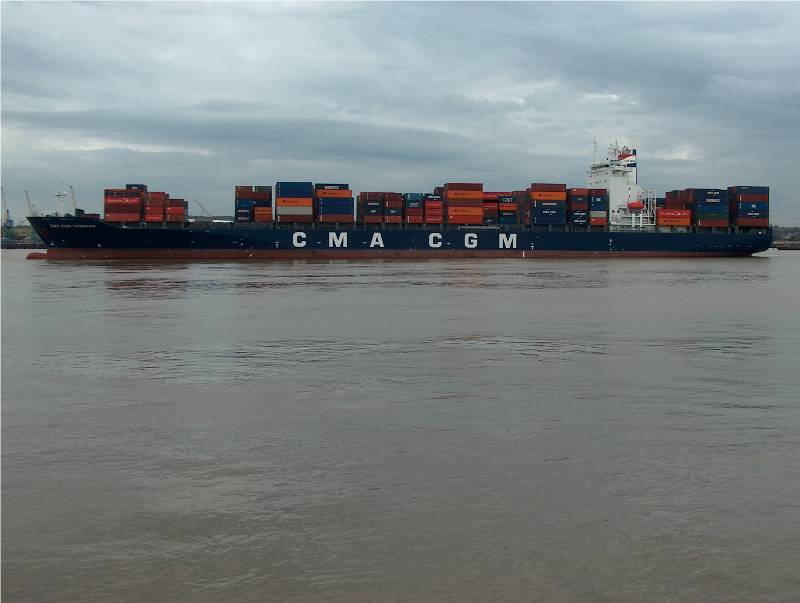
"...Shipping is the thermometer of global trade. It allows us to take the broadest view of the health of the worldwide economy." So says transportation economist Oliviero Bacelli, quoted in this interesting Time article on the effect of the credit crunch on shipping.
I am reminded of a conversation I had with a good friend of mine as we sat along the Thames watching tugboats push heavy crates of cargo up and down the river. He mentioned that he really enjoyed watching this happen because it reminded him that this is what trade ultimately comes down to: moving boxes from one place to another. Internationl transactions now involve complex derivatives, currency hedges and whatnot, but at the end of the day 77% of global trade is the result of ships moving boxes from one place to another.
This is why it should be particularly worrying that the credit crunch has moved from threatening the jobs of investment bankers to threatening the jobs of shipping and dock workers. The Baltic Dry Index, which measures freight rates for bulk goods, has dropped 96% since May - an incredible display of volatility. Granted, it appears to be a pretty volatile index to begin with and we're currently not far off from pre-2003 levels. But export-oriented economies are hurting badly, particularly the East Asian tigers that are still licking wounds from their own financial crisis a decade ago.
In addition to the costs felt by workers and firms, new ship-building orders are being cancelled regularly. That will dampen the ability of shipping companies to meet demand when it resumes again - clearly an unhappy prospect.
However, some possible good news yesterday coming from the WSJ blog: a recent bump in the Index. FT Alphaville notes that this could be a side-effect of optimism about Obama's expected stimulus package and speculates about some other industries that may benefit as well. But with the medium-term prospects of shipping being what they are, can we expect this uptick to last?
Tuesday, 9 December 2008
May You Live In Interest-Free Times
The interest on US T-bills briefly hit the negatives today as investors pushed the yield to -0.01%. A negative interest rate means that you are paying the debtor for the privilege of owing you money. Wow.
A better way to look at the world
I've been meaning to post this since hearing a piece about Worldmapper on NPR a couple of weeks ago. Worldmapper has created a selection of maps, published in the new book The Atlas of the Real World, that proportion countries according to different demographic and economic categories. The maps are intended to challenge common perceptions of space, size and power. A selection below:
Crude Petroleum Exports, 2002

 Finance and Insurance Services Exports, 2002

Crude Petroleum Exports, 2002
Internet Users, 2002.
10 Worst Predictions of 2008
FP Passport counts down the 10 Worst Predictions for 2008.
Are there any poor predictions FP Passport has overlooked? Let us know what you think deserves to make the list.
Are there any poor predictions FP Passport has overlooked? Let us know what you think deserves to make the list.
Monday, 8 December 2008
Zuma does his best Mbeki impression
Jacob Zuma has shamefully countered global appeals for Mugabe's removal, and the people of Zimbabwe lose again.
Quick hits and pink picks
-John Thain wants his 2008 bonus, reportedly $10m. Two ways to look at this: 1) his social and political thermometers are broken, or 2) he deserves it. Despite all of his misleading statements on the health of Merrill Lynch and role in its eventual acquisition by Bank of America, he did secure the sale of the firm at $28 a share. Remember what Bear went for? My take: I recognize point 2, but agree with point 1. He's insane for asking, and his compensation committee would be crazier to approve. UPDATE: Apparently, someone told him this whole bonus demand was a bad idea, because he no longer wants it.
-The FT has an interesting article on today's elections in Quebec. The economy trumps sovereignty, a good sign for Liberals.
-The Pulitzer Prizes have expanded to cover online only publications. IPE Journal submits itself for consideration.
-Petroleum Intelligence Weekly has released its influential annual rankings of the world's top oil companies. The report highlights the increasingly marginalized position of the traditional private oil majors, and growing global market dominance of majority state-owned companies. This trend towards nationalization and state control of increasingly scarce resources has a number of powerful implications.
Innovation at Afrigadget.com
Check out this cool website "dedicated to showcasing African ingenuity." Definitely makes you think twice about throwing stuff away.
Things I've found over lunch today:
- Togolose inebriation innovation
- USAID bags used to insulate homes
- Some very cool handmade toys
Sunday, 7 December 2008
Bob Gates, US foreign policy and missile defense
 "Support for conventional modernization programs is deeply embedded in the Defense Department's budget, in its bureaucracy, in the defense industry, and in Congress. My fundamental concern is that there is not commensurate institutional support -- including in the Pentagon -- for the capabilities needed to win today's wars and some of their likely successors."
In an essay to be published in Foreign Affairs, US Secretary of Defense Robert Gates outlines his vision for American foreign policy. I purposely say foreign policy (as opposed to military/defense policy), because Gates wants to balance the Pentagon's institutional preference for grand, high end (low probability, high impact) projects with a greater capacity to fight unconventional, low-end (high probability, low impact) conflicts. For Gates, this includes a renewed commitment to the soft power America deployed so effectively during the Cold War. He is likely the first defense secretary in history to call for the defense budget to be cut in favor of greater funding for State.
I am a big fan of Gates. His vision, pragmatism and action have all helped repair some of the damage inflicted by Donald Rumsfeld. His call for the Pentagon to confront "inescapable tradeoffs and opportunity costs" is a refreshing alternative to defense spending under the Bush administration. As a former intelligence officer and head of the CIA, he seems to posses a higher level understanding of what American power is and how it must adapt to a dynamic and complex world.
Gates doesn't dismiss high end programs and his call for "balance" doesn't imply their scrapping all together. That would be crazy. But if he is serious about developing new US defense priorities and standards, he must extend his metrics universally and tackle the most bloated, strategically questionable and institutionally embedded programs. Unfortunately, he seems to exclude one very big conventional program: the missile defense shield.
His clear desire to temper the Pentagon's institutional preference for conventional modernization programs contrasts with his public support for the US missile defense shield. I believe the location of US missile defense installations in Eastern Europe is a strategic mistake. It is also irrelevant to the "wars of today". I'm sure his robust public support for the program is in part a power play directed at Russia. After the war in Georgia, the US has little direct leverage in the region. With the EU effectively ruling out a further eastward expansion, and the incorporation of Ukraine and Georgia into NATO too explosive an issue, the missile defense shield might be America's only bargaining chip in the region.
The importance of countering Russia in Eastern Europe and the Caucasus is clear. But the US has other tools in its diplomatic arsenal, and a little backbone by the EU would go a long way towards re-balancing the power dynamics. Which brings us back to Gates. The missile defense shield is exactly the kind of program Gates wants to move the Pentagon away from. If he simply applied his own metrics to the program, its utility in fighting "today's wars" would be evident. The question is whether the opportunity costs of the program, and the strategic costs of its location in Europe, justify its position at the top of the US defense/foreign policy agenda. In my opinion, it does not. Bob Gates is a terrific defense secretary. But he is wrong on missile defense.
Subscribe to:
Posts (Atom)


 Posts


